The Knights of Hilbringen – The Noble Family “de Hilbringen”
The history of Schloss Hilbringen begins with the noble family known as “de Hilbringen”. On the site where Schloss Hilbringen stands today, the medieval seat of the Knights of Hilbringen may once have been located. It is known that an older estate or fortified residence was demolished before 1745 and that the present castle was later built on this site.
At the time of the first historical references, Hilbringen belonged to the Duchy of Lorraine and later to the Duchy of Lower Lorraine. The Knights of Hilbringen are historically documented as feudal lords, knights and squires.
The first known reference dates back to the year 1312, when a certain Watrins de Hildebranges escuier appears in historical records. The village of Hilbringen, today a district of Merzig, is regarded as the ancestral seat of the noble families bearing this name.
Names Mentioned in Historical Records
- Before 1312: Watrins de Hildebranges, his son Hesse and two daughters sell their estates.
- 1369: Hesse von Helleberigne and his son Arnoul in the service of the city of Metz.
- 1438: Johanns von Hillbringen, feudal record concerning half the village of Fuckingen.
- 1452: Johann von Hilbringen as a vassal of Trier.
- 1486: Thomas von Hilbringen as a vassal of Trier.
- 1511: Jacob von Hilbringen.
- 1522: Mathias von Hilbringen.
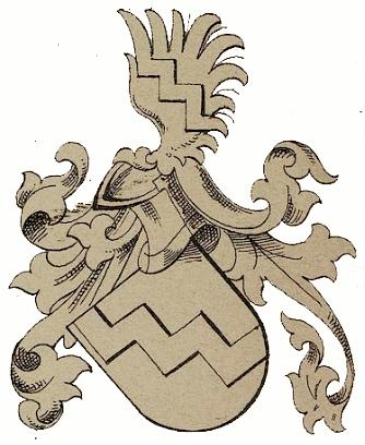
Johann de Hilbringen sealed with a shield showing a diagonal zigzag bar. The helmet displays a wing marked in the same way.
The traces of the “de Hilbringen” family lead further to Siersburg, Sierck, Wiltz and Arlon. Similarities between their coat of arms and those of the Lords of Siersburg suggest possible family connections. The Knights of Hilbringen also held rights and estates in places such as Fuckingen, Fremersdorf, Silwingen, Hargarten and Rehlingen.
The d’Huart Family
The d’Huart family plays an important role in the further development of Schloss Hilbringen. Through purchase, inheritance and marriage, the connections between the Knights of Hilbringen and the later de Maurice family can be traced.
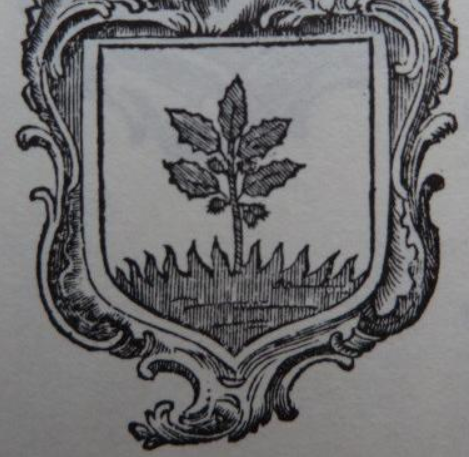
In silver, rising from five red flames, a green holly branch with red berries.
Johann Huart – Lieutenant General of the German Bailiwick
Johann Huart from Wallerfangen was an important jurist and, from 1595, Lieutenant General of the German Bailiwick, the largest administrative district of the Duchy of Lorraine. He translated the Lorraine legal code into German and advocated reforms of the witch trials.
On 16 May 1617, Johann Huart was ennobled by Duke Henry III of Lorraine. As early as 1611, the d’Huart family was already in possession of Schloss Hilbringen. In 1612, Johann Huart purchased the so-called Hesse estates together with Nikolaus von Weis. Johann Huart received the lordship of Hilbringen with the house located there, which later became Schloss Hilbringen.
Through his daughter Catharina, who married Erhard Humbert, the estate passed to the Humbert family. The d’Huart family therefore forms an important bridge between the medieval ownership history and the later history of the castle.
The de Humbert Family
Catharina Huart married Erhard Humbert around 1620. In 1622, he succeeded his father-in-law as Lieutenant General. Their marriage produced Georg Friedrich, also known as Georges Ferry de Humbert. Through inheritance from his mother, he received the Hilbringen estates and is documented as having lived there.
In the notarial records of Wallerfangen, Georg Friedrich de HUMBERT of Hilbringen is mentioned several times, including in 1687 and 1697 as a lessor of land. The Humbert family managed and inhabited the estate over several generations.
The de Maurice Family
The noble ancestor of the Rhenish family was Francois Didier Maurice, who was granted nobility on 28 March 1708 by Duke Leopold of Lorraine. His descendants Johann Franz Georg and Aegidius von Maurice were entered into the Rhenish register of nobility in 1830.
The family originated in Brittany. Francois Didier de Maurice married Marie Margaretha de Urbain. His son Heinrich Joseph de Maurice purchased a house on Siersburg Castle and married Apollonie de Humbert. Their son Jean Philipp de Maurice lived in Hilbringen and married Elisabeth Strasser.
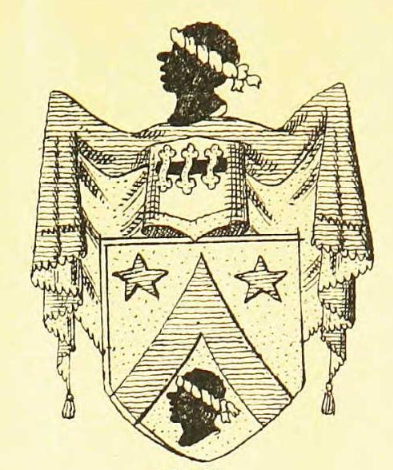
A golden shield with a blue chevron, two blue stars and a Moor’s head.
One important descendant was Ägidius de Maurice, who was entered into the Prussian register of nobility in 1830 but later used the name Moritz. In 1847, he emigrated to North America with two sons and a daughter. The widely branched Moritz family descends from him.
A deed of sale dated 5 June 1771 shows that the brothers Joseph de Maurice de Hilbring and Philipp de Maurice de Siersberg appeared as witnesses. Joseph called himself “de Hilbring” because he was a co-lord of the lordship of Hilbringen through the inheritance of his mother Apolline de Humbert and lived in the castle.
The Present Baroque Castle
The present baroque castle was built between 1733 and 1745 for the de Maurice family according to plans by Christian Kretzschmar. The earlier structure was completely demolished for this purpose. Schloss Hilbringen therefore combines medieval ownership history with baroque architecture.
Owners of Schloss Hilbringen – Overview
The following owners and noble families can be traced since the Middle Ages:
- 13th–15th century: Knights of Hilbringen, first mentioned in 1312
- 15th–16th century: Hesse von Hilbringen, later also known as “von Koensdorf”
- From 1612: Johann Huart through the purchase of the Hesse estates
- From around 1622: The Humbert family through marriage
- From around 1730–1740: The de Maurice family through inheritance and marriage to Apollonie de Humbert
- 1854–2020: Sale to the tannery owner Altmeyer, then privately owned for generations
- Since July 2020: Acquisition by ACT Projekt GmbH & Co. KG and renovation into a modern apartment residence
Sources & Literature
The information summarized here is based on historical research, genealogical records, heraldic books, archive material and the chronicle by Uwe Bohrer.
- Siebmacher, Johann – Heraldic books
- Archives of the Hospices de Luxembourg
- Annals of the Luxembourg Archaeological Institute
- Study by Guido Müller: “Der Generalleutnant der Deutschen Ballei Johann Huart”
- Notarial records of Wallerfangen
- Theodor Liebertz: “Wallerfangen und seine Geschichte”
- Henri Hiegel: Le Bailliage d’Allemagne de 1600 à 1632
- Hans Leisten: Hilbringer Heimatbuch
- Généalogie et histoire Uwe Bohrer
The complete documentation with further details, family trees, source references and historical coats of arms can be found in the PDF archive linked above.
Remarkable Details from the Chronicle
Particularly remarkable is the connection between several noble families through purchase, inheritance and marriage. Schloss Hilbringen therefore represents not merely a single building, but a long line of regional rulership, family history and ownership in Saarland and historic Lorraine.
The coat of arms of the Lords of Siersburg displays similar diagonal bar motifs, suggesting possible shared roots. In the council hall of Dillingen, a painting by Otto Günther Naumburg depicts the return of the Lords of Siersberg and Dillingen from the enfeoffment ceremony of 1333.
Stay Within Centuries of History
Discover our lovingly restored holiday apartments at historic Schloss Hilbringen and experience the atmosphere of this remarkable estate first-hand.
View Holiday Apartments